Guide · 1509 words · updated 2026-11-23
How to sell USDT on P2P (and get paid without surprises)
When you sell, the risk is on your side: you're the one who releases the USDT. The golden rule has no exceptions: never release without seeing the money credited to your account.
In this guide · 14 sections
- What changes when you sell
- Before you sell
- How much you'll get: an example
- Step by step
- How to really check the payment
- Taking an ad or posting your own
- Warning signs when selling
- Protecting your bank account
- When to sell
- If something goes wrong
- Choosing a good buyer
- Common mistakes when selling
- Selling USDT you received from abroad
- Frequently asked questions
What changes when you sell
When you buy USDT, the exchange protects your money by locking the seller's USDT. When you sell, you're the one whose USDT gets locked: when the order opens, your USDT goes into escrow and the buyer receives your payment details. They pay you outside the exchange, and you decide when to release.
That means the only person who can make a mistake and lose is whoever releases too early. If you never release before seeing the money in your account, the system protects you. Almost every scam against sellers tries exactly that: getting you to release first.
Before you sell
- Keep your USDT in the right wallet. On most exchanges P2P uses the funding or P2P wallet, not spot or futures. Moving between internal wallets is free and instant.
- Add your payment methods. Register your bank account or wallet, in your own name, in your P2P profile.
- Check your bank limits. If you'll receive a large amount, make sure your bank or wallet accepts it in one transfer.
- Pick a time when you can check your bank. You'll need to look at your account to confirm the payment.
How much you'll get: an example
Say you have 200 USDT and the best buyer in your country pays 1,760 pesos per USDT. You'd get 352,000 pesos. If someone on another exchange pays 1,765, that's 353,000: a thousand pesos more for two minutes of comparing. With large amounts those differences add up fast.
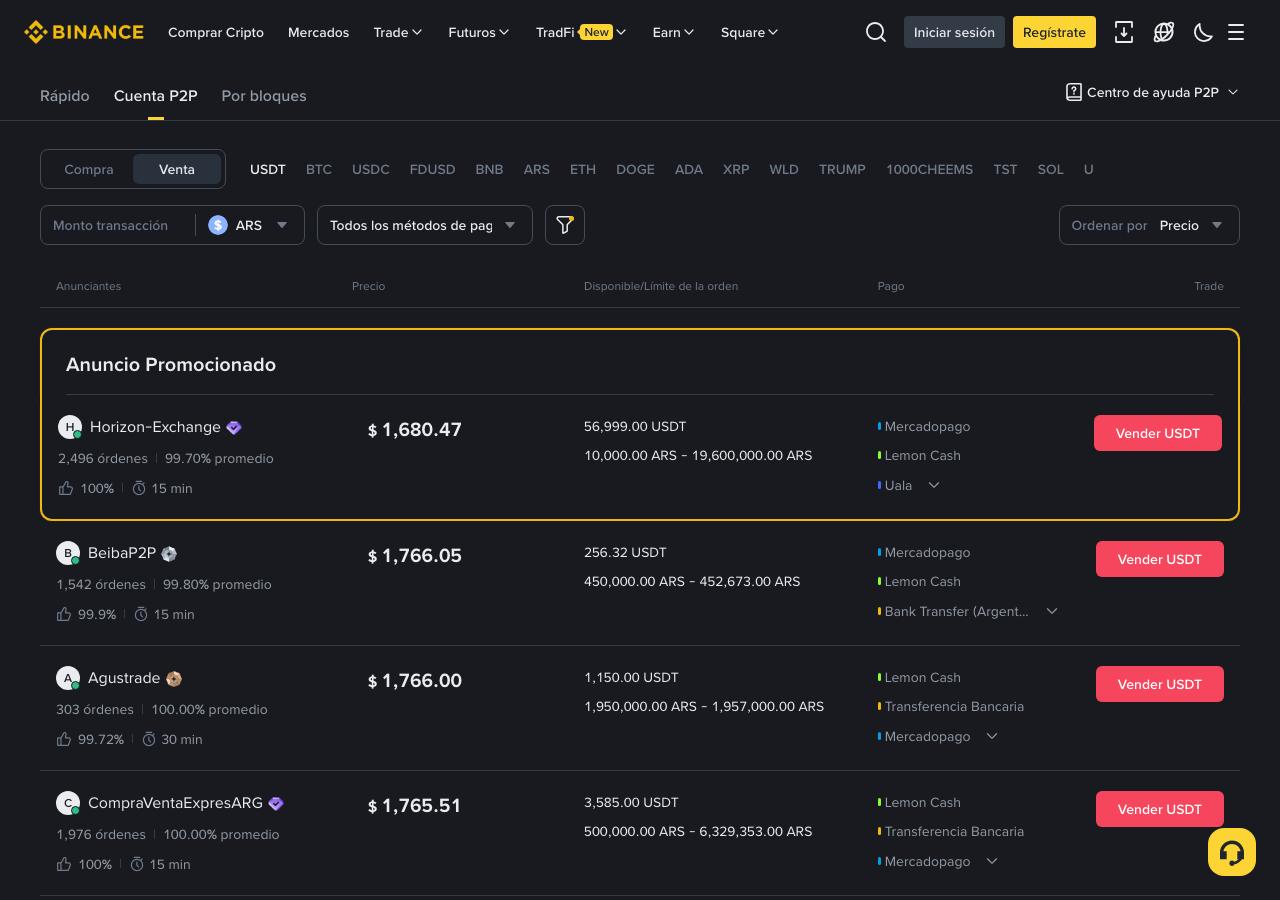
Mind the buyer's limits too: if their ad accepts between 50,000 and 300,000 pesos, you can't sell them all 200 USDT at once and you'll need another buyer or to split the sale. On CoinCTC, choosing "Sell" and entering your amount shows only buyers who accept the whole amount.
On most exchanges whoever sells by taking an ad pays no P2P fee, but check yours. If you post your own ad, some exchanges charge the advertiser a small fee.
Step by step
- Compare the sell price on CoinCTC. The best buyer may be on another exchange or pay more for a particular payment method.
- Go to P2P → Sell, choose USDT and your local currency, and filter by your payment method.
- Choose a buyer with a good record (many orders, high completion rate) whose range includes your amount.
- Open the order. Your USDT is locked and the buyer sees your payment details.
- Wait for the payment and, when the buyer marks it done, check your bank or wallet — not the exchange app or a screenshot.
- Check amount and sender: the money must be credited, for the exact amount, from an account in the buyer's name.
- Release the USDT. Once released there's no going back, so this is the last step, never the first.
How to really check the payment
This is where most people slip. A buyer can mark the order as paid without paying, or send you an edited screenshot. Neither is a payment. The only thing that counts is seeing the balance credited in your account, opening your bank or wallet yourself.
Also check the sender's name. If the money comes from someone other than the buyer, don't release: it may be triangulation (someone scammed a third party and told them to pay you). Return the money to the sender's account and cancel or appeal, explaining the situation to support.
If the amount received differs from the order, don't release either. Message the buyer in the order chat and, if it isn't resolved, open an appeal.
Taking an ad or posting your own
There are two ways to sell on P2P. The most common is taking a buyer's ad: pick someone from the list, open the order and wait for payment. It's quick and needs nothing special.
The other is posting your own sell ad, with your price, limits and payment methods, so others find you. It can make sense if you sell often or in large amounts, but you need to watch orders, reply quickly and meet the exchange's requirements. To start, taking ads is simplest.
Warning signs when selling
- The buyer rushes you: "release now, the bank is slow", "I have to go".
- They send screenshots instead of waiting for you to see the money.
- They ask for your WhatsApp or Telegram "to coordinate better".
- The payment comes from someone else's or a company's account.
- They ask you to cancel and reopen the deal outside the exchange.
- The profile has very few orders yet offers to pay more than everyone.
Protecting your bank account
One risk when selling USDT isn't losing the USDT, but your bank freezing your account for receiving suspicious money. It happens mostly with third-party payments or many deposits from different people in a short time. Some habits help:
- Accept payments only from the order's buyer. If it comes from someone else, send it back.
- Consider a dedicated account or wallet for P2P, separate from your salary and expenses.
- Keep everything: order number, receipt, buyer's name. If the bank asks, you can explain each movement.
- Prefer verified buyers with long histories: they're less likely to pay with third-party money.
- Don't accept odd references or payments split across several accounts.
When to sell
There's no perfect moment, but there are hints. The sell price tends to improve when many people want USDT: during currency nerves, at month-end when people get paid and want dollars, or when the official dollar rises. When many people need local currency at once, buyers may pay less.
If you need the money now, sell and compare buyers well. If you can wait, look at your country's history on CoinCTC. And for large amounts, consider selling in parts: you don't depend on a single price and it's easier to find buyers whose limits fit.
If something goes wrong
If the buyer marked the order as paid but the money doesn't show up, don't release and don't cancel: wait a reasonable time for your bank and, if it still doesn't appear, open an appeal. While the order is disputed, your USDT stays locked and nobody can take it.
If you received a third-party payment, don't use it. Keep the receipts, tell exchange support through the appeal and follow their instructions. If your bank contacts you about the transfer, explain what happened with the receipts at hand.
Choosing a good buyer
Not every buyer is equal, even at the same price. Look at the number of completed orders, the completion rate and how long the account has been active. A buyer with thousands of orders and 98% completion has a lot to lose by misbehaving; a brand-new account offering the highest price deserves more caution.
Read the ad terms too. Good buyers state clearly that they pay only from accounts in their own name, which is exactly what you want. If the terms ask you to contact them outside the exchange, skip the ad: there are always other buyers.
Common mistakes when selling
- Trusting the "paid" button. The buyer marking the order as paid proves nothing; only your bank balance does.
- Checking the notification instead of the account. Bank SMS and emails can be faked; open the app and look at the balance.
- Releasing to be polite. If the buyer insists, it's even more reason to wait until the money is credited.
- Ignoring the sender's name. A payment from a third party is a red flag, even if the amount is right.
- Selling with the wrong wallet. If your USDT is in spot, move it to funding before opening the order.
Selling USDT you received from abroad
Many people in the region get paid in USDT for freelance work or receive it from family abroad. In that case, check first that the deposit arrived on the right network and is in your funding wallet. Then compare the sell price across exchanges: the difference between the best and an average buyer can be larger than the fee you paid to receive the money.
Frequently asked questions
- How long does the money take? It depends on the buyer's method: with instant wallets and transfers, a few minutes. Some banks take longer; wait until it's credited.
- What if the buyer doesn't pay? The order expires or they cancel it, and your USDT returns to your wallet. You never lose it if you didn't release.
- Can I sell only part of my USDT? Yes, you choose the amount in each order, within the buyer's limits.
- Do I have to pay taxes? It depends on your country and on whether you made a gain. Keep receipts and ask an accountant.
- Where do I get paid best? It changes minute by minute. On your country's page on CoinCTC, pick "Sell" and enter your amount.
Selling USDT on P2P is as safe as your discipline: the system protects you as long as you don't release before seeing the money.